What is the Vortex OT SOC?
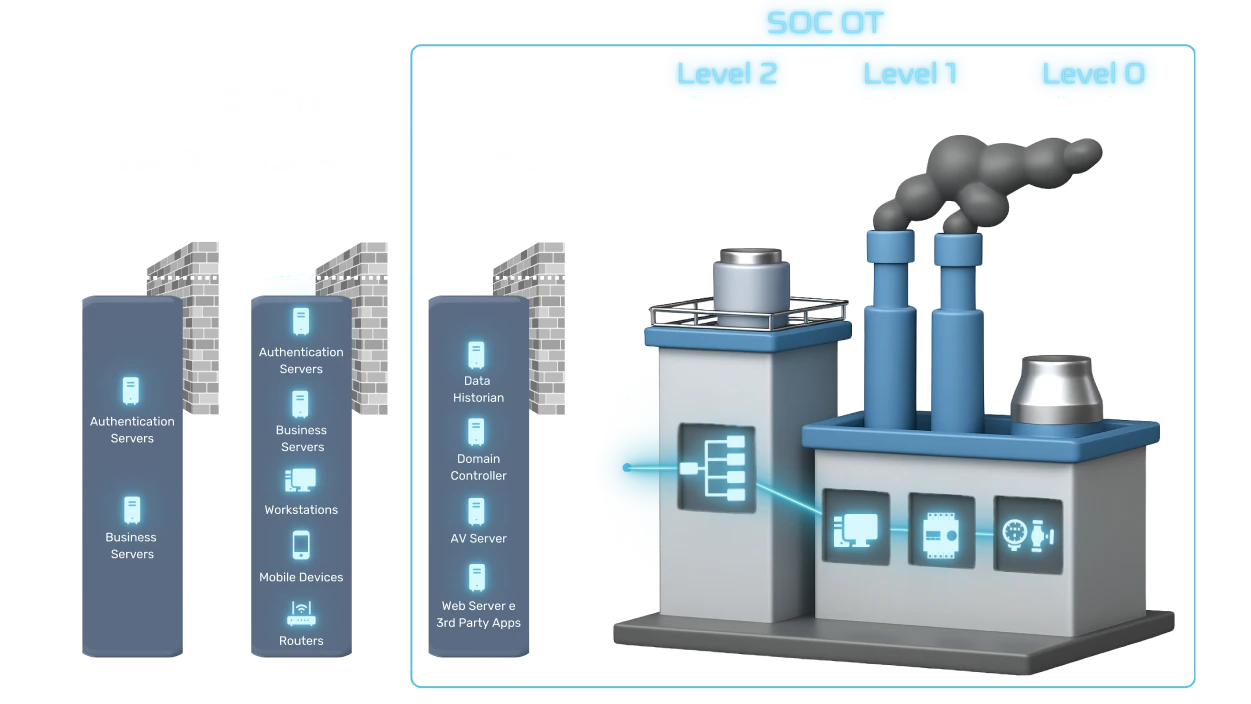
It is a cell of the Cyber Defense Center, the Vortex NG-SOC Convergente, specialized in industrial environments, ICS and cyber-physical systems (CPS), with 24x7x365 monitoring. Its analysts are trained in industrial security and know OT protocols and processes, and the playbooks respect the plant’s operational constraints. The focus is uninterrupted operation.
Why monitor IT and OT in the same SOC?
Because when the attack enters through the corporate network and reaches the plant, an IT-only SOC sees disconnected alerts and leaves OT out of view. In the NG-SOC Convergente, industrial telemetry is correlated with IT events, and the attack appears end to end, from phishing in the office to an attempt to manipulate a controller at the plant. According to Claroty’s Industrial Buyers Guide, 32% of respondents had both IT and OT systems impacted in the same attack, up from 21% the previous year.
Does OT monitoring interfere with production?
Monitoring is designed to protect the process without stopping production. Discovery and inventory of OT assets are passive, with no operational impact, which matters because there are legacy assets that cannot take agents. Response playbooks respect the plant’s operational constraints, and vulnerability management respects industrial maintenance windows.
Does Vortex work with IEC 62443?
Yes. Vortex applies IEC 62443 in OT environment assessments, defining zones, conduits and security levels, and links each recommended control to the requirements of ISA/IEC 62443-3-3 for the target security level (SL-T). In the water and sanitation case, the ISA/IEC 62443-3-2 Cyber-PHA brought unacceptable risk to zero without replacing the installed automation base.
What is the difference between vulnerability and risk in OT?
A list of CVEs tells you what exists on the network; risk tells you what happens to the process if an automation function is compromised. The Vortex Risk Assessment uses the Cyber-PHA of ISA/IEC 62443-3-2 and measures risk from 1 to 25 by severity and likelihood, with the consequences for people, the environment, finances and reputation. The vulnerability scan still exists, but it serves as evidence for likelihood, not as the final result.
How does the OT Risk Assessment work, and what does the company receive?
There are five steps and two workshops: scope and stakeholders, reference threat actor, functions and consequences by Purdue level, severity and likelihood and, finally, risk, controls and residual risk. The company receives the complete Cyber-PHA, the IT and OT asset inventory, the vulnerability survey, the NIST SP 800-82 compliance assessment with ranked gaps, the ISA/IEC 62443-3-3 controls by security level, the current topology and the target architecture, and an executive report for the board, with investment guidance.
Does Vortex comply with the ONS cybersecurity routine?
Yes. Vortex has completed dozens of projects to comply with routine RO-CB.BR.01 of the ONS, Brazil’s National Electric System Operator, and its OT services meet the controls of the Regulated Cyber Environment (ARCiber), such as asset inventory, operational DMZ, remote access via VPN, patch management, access control and monitoring.
How do attacks on industrial environments begin?
In most public cases, through a simple point of entry: a phishing email, remote access or VPN, leaked credentials or a supplier, like the compromised software update that brought NotPetya to Mondelez. When the attack enters through the corporate network and moves on to the plant, correlation between IT and OT helps detect this lateral movement early.